

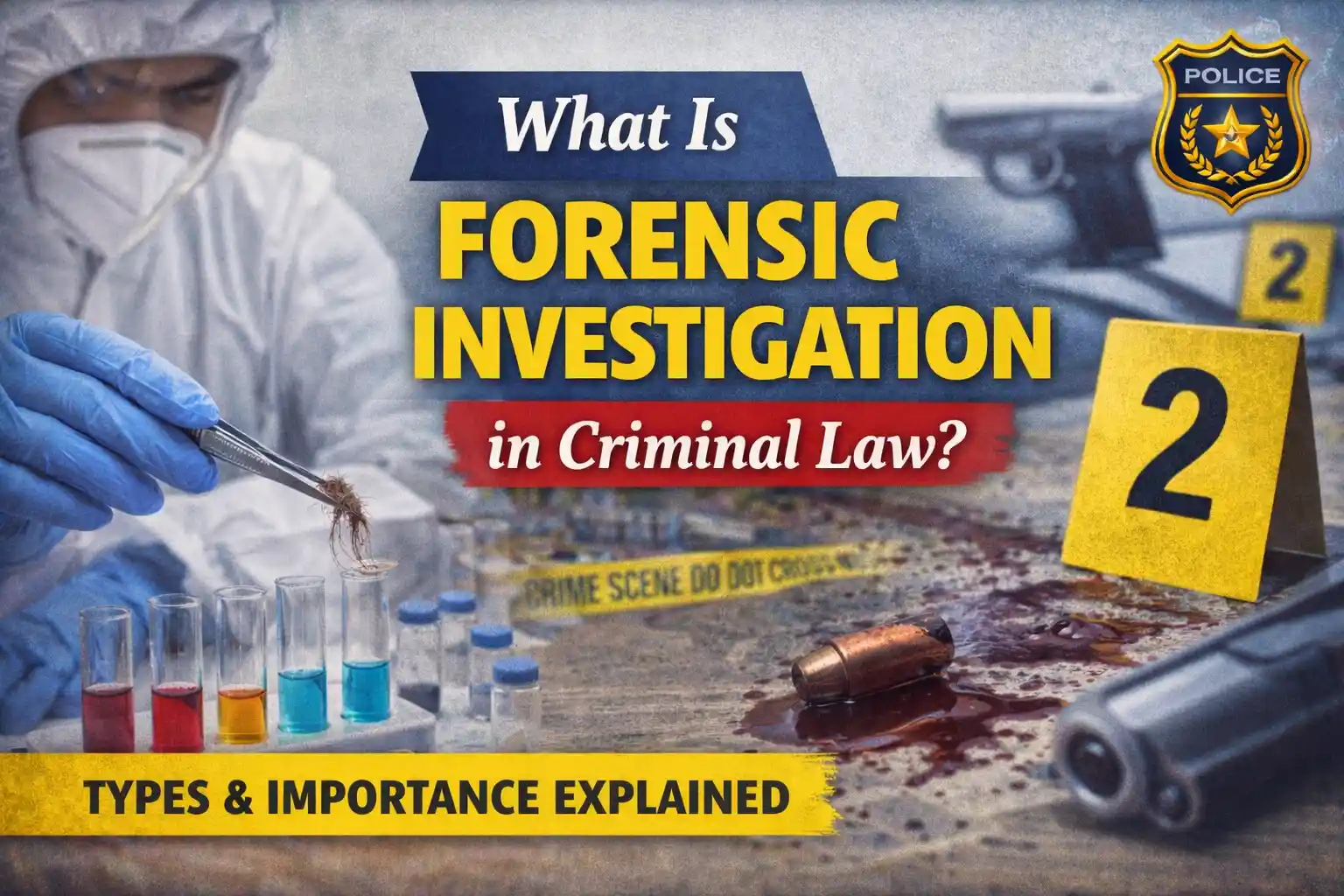
Forensic investigation is a scientific method of collecting, preserving, analyzing, and presenting evidence related to a crime. It applies principles of science to assist courts in determining the truth.
The term “forensic” originates from the Latin word forensis, meaning “before the court.” Therefore, forensic investigation refers to scientific investigation intended for use in legal proceedings.
Legal Context in India
Forensic investigation forms part of criminal investigation under the Code of Criminal Procedure (CrPC).
Courts rely on forensic evidence under the Indian Evidence Act, especially when expert opinions are involved.
In India, forensic examinations are typically conducted by government laboratories such as the Central Forensic Science Laboratory (CFSL).
Purpose of Forensic Investigation
The main objectives are:
To scientifically analyze crime scene evidence
To identify suspects through objective testing
To reconstruct events of the crime
To provide expert testimony in court
To eliminate false accusations
Unlike eyewitness accounts, forensic evidence is based on measurable scientific principles.
- Private Detective Agency in Delhi
- Divorce case detective in delhi ncr
- Pre matrimonial detective agency in delhi ncr
- female private investigators
- Detective agencies east delhi
- Corporate Investigation Services
Types of Forensic Investigation
1. DNA Analysis
Used to identify individuals through biological samples such as blood, hair, saliva, or tissue.
2. Fingerprint Examination
Unique fingerprint patterns are compared to identify suspects.
3. Digital Forensics
Recovery and analysis of data from mobile phones, computers, and servers.
4. Ballistics Examination
Analysis of firearms, bullets, and cartridge cases.
5. Toxicology
Detection of drugs, poison, or chemicals in the body.
6. Document Examination
Verification of handwriting, signatures, and forged documents.
Process of Forensic Investigation
1. Crime Scene Preservation
Police secure the scene to prevent contamination.
2. Evidence Collection
Physical evidence is collected using scientific methods.
3. Laboratory Analysis
Samples are sent to forensic laboratories for testing.
4. Expert Report Preparation
Experts prepare detailed scientific reports.
5. Court Testimony
Forensic experts may appear in court to explain findings.
Importance of Forensic Investigation
Forensic investigation:
Reduces wrongful convictions
Strengthens prosecution cases
Supports defense arguments where evidence favors accused
Ensures scientific objectivity in criminal trials
The Supreme Court has emphasized the importance of scientific investigation in ensuring fair trials under Article 21 of the Constitution.
Difference Between Forensic Investigation and Regular Investigation
| Forensic Investigation | Regular Police Investigation |
|---|---|
| Based on scientific analysis | Based on witness statements and inquiry |
| Conducted by forensic experts | Conducted by police officers |
| Laboratory-based evidence | Field-based evidence |
| Objective and measurable | May involve subjective elements |
Both work together in criminal cases.
Conclusion
Forensic investigation is the scientific examination of evidence to assist courts in determining guilt or innocence. It plays a critical role in modern criminal justice by ensuring decisions are based on reliable, objective, and scientifically tested evidence.
Frequently Asked Questions (FAQ)
Forensic Investigation in Criminal Law
1. What is forensic investigation?
Forensic investigation is the scientific examination of crime scene evidence to determine facts and assist courts in delivering justice.
2. How is forensic investigation different from regular police investigation?
Regular investigation focuses on witness statements and field inquiry, while forensic investigation relies on scientific testing and laboratory analysis of evidence.
3. Which law governs forensic investigation in India?
Forensic investigation forms part of criminal procedure under the Code of Criminal Procedure and expert evidence is recognized under the Indian Evidence Act.
4. What are common types of forensic investigation?
Common types include DNA analysis, fingerprint examination, digital forensics, ballistics, toxicology, and document examination.
5. Who conducts forensic investigation in India?
Forensic analysis is usually conducted by government laboratories such as the Central Forensic Science Laboratory (CFSL) and state forensic science laboratories.
6. Is forensic evidence admissible in court?
Yes. Forensic reports are admissible as expert evidence, and forensic experts may testify in court to explain their findings.
7. Why is forensic investigation important?
It ensures objectivity, reduces wrongful convictions, strengthens criminal cases, and supports fair trials.
8. Can forensic evidence alone convict a person?
In many cases, strong forensic evidence such as DNA may significantly influence conviction. However, courts assess it along with other evidence.